
You are here
News
Nike Force Utility, Nike Force Batting Gloves Nike Force 1 Trainers, Nike Force David Robinson, Nike Force Trout 6 PRO Mcs Bg - Boys' Grade School Wolf Grey/white/cool Grey
News
Project Blogs - Click on any of the links to be taken to the blog:
Sustainability in Ukraine Urban Architecture & Politics in Eastern Europe Sustainable Urbanism in Lowrey Redevelopment Downtown Sustainable Urban Redevelopment on Welton Street Greenbuilding in Guatemala Sustainable School Construction in Guatemala Denver Eco-City Development at Sun Valley Zero Energy DOE Competition for Housing in Downtown Denver Eco-City & Sustainable Urbanism in the Denver National Western Stock ShowAfter many years of work and development, Fred's High-Tech Greenbuilding Resource Guides are slated for world-wide publishing!!! The Resource Guides will be published by Elsevier Publishing and will take the green design world by storm next summer. You can get a preview of the Resource Guides by clicking on the link below
Click Here for a Preview of the Resource Guides
We are pleased to announce that Fred Andreas AIA and Dr. John Zhai will speak this week in Washington DC at the National Science Foundation's (NSF) Emerging Frontiers in Research and Innovation (EFRI) National Conference
 Fred Andreas AIA and Dr. John Zhai will speak this week in Washington DC at the National Science Foundation's (NSF) Emerging Frontiers in Research and Innovation (EFRI) National Conference concerning their NSF funded project “Living Wall Materials and Systems for Automatic Building Thermo-Regulation”. With the goal of achieving net-zero-energy buildings in the U.S. by 2030, this project will develop intelligent and integrated building envelope systems with smart materials and innovative structures, upon a series of advanced and multi-disciplinary studies on Zero Net Energy Buildings (ZNEB), passive commercial building strategies, material science, structure engineering, heat transfer, fluid mechanics, system optimization, and architecture integration. The 5 year research grant funds integrated and interdisciplinary building systems research into a new generation of ZNEB buildings.
The research team includes:
PI: John Zhiqiang Zhai
CO PI’s:
Fred Andreas, AIA, LEED AP CAP
YiFu Ding
Kurt Maute
Jerry Qi Hang
College of Applied Science and Engineering
University of Colorado Boulder
Fred Andreas AIA and Dr. John Zhai will speak this week in Washington DC at the National Science Foundation's (NSF) Emerging Frontiers in Research and Innovation (EFRI) National Conference concerning their NSF funded project “Living Wall Materials and Systems for Automatic Building Thermo-Regulation”. With the goal of achieving net-zero-energy buildings in the U.S. by 2030, this project will develop intelligent and integrated building envelope systems with smart materials and innovative structures, upon a series of advanced and multi-disciplinary studies on Zero Net Energy Buildings (ZNEB), passive commercial building strategies, material science, structure engineering, heat transfer, fluid mechanics, system optimization, and architecture integration. The 5 year research grant funds integrated and interdisciplinary building systems research into a new generation of ZNEB buildings.
The research team includes:
PI: John Zhiqiang Zhai
CO PI’s:
Fred Andreas, AIA, LEED AP CAP
YiFu Ding
Kurt Maute
Jerry Qi Hang
College of Applied Science and Engineering
University of Colorado Boulder
We are very excited to announce that the University of Colorado - Denver won Most Innovative in HEI Hotels and Resorts at the Better Buildings Case Competition held by the U.S. Department of Energy!
 As part of its support for the Better Buildings Challenge, the DOE recently held a student case competition. Students in university energy clubs tackled cases that focused on a number of the most common, most stubborn barriers to energy efficiency in both the private sector and in state and local settings. The cases used real scenarios, information, and data provided by Challenge Partners and others in the commercial buildings industry. Through the Better Buildings Case Competition, the DOE was seeking creative and innovative solutions to these barriers that could be implemented by Challenge Partners thereby serving as "models for success" for the marketplace.
The student teams competed to find the best solutions to the energy efficiency challenges presented in real-world case studies for the City of Houston, the District of Columbia, HEI Hotels and Resorts, and Cassidy Turley, a major commercial real estate firm.
The students were judged on the merits of their written proposals and oral presentations, delivered to a panel of commercial real estate and energy experts. Two winners were recognized for each case study for the most innovative solution and the best proposal and were judged on criteria including: considering policy, finance, business strategy, and program design; developing realistic, scalable, and implementable solutions; and analyzing the potential outcomes and likelihood of success.
HEI Hotels and Resorts: Most Innovative – University of Colorado, Denver
The UCD team consisted of an interdisciplinary team from IGERT and CAP with Architecture students Meg Sheff-Atteberry and Jessica Weyandt and IGERT team members Tyler Huggins, James Scott Brew, Kyle Dunn, Brian MacDonald, Nathan Clark and Aaron Nelson with external advisor James Scott Brew AIA LEED AP from the Rocky Mountain Institute and faculty advisor Fred Andreas AIA LEED AP. The team presented three options to help hotel operators reduce their energy costs by adjusting their operations, which will save energy and allow the hotels to improve performance with no investment by the franchisor. To accomplish this, the hotel owner would request a two-year extension of the performance improvement plan, and the franchisor would defer $420,000 in royalties this year to be invested into performance-enhancing measures next year.
As part of its support for the Better Buildings Challenge, the DOE recently held a student case competition. Students in university energy clubs tackled cases that focused on a number of the most common, most stubborn barriers to energy efficiency in both the private sector and in state and local settings. The cases used real scenarios, information, and data provided by Challenge Partners and others in the commercial buildings industry. Through the Better Buildings Case Competition, the DOE was seeking creative and innovative solutions to these barriers that could be implemented by Challenge Partners thereby serving as "models for success" for the marketplace.
The student teams competed to find the best solutions to the energy efficiency challenges presented in real-world case studies for the City of Houston, the District of Columbia, HEI Hotels and Resorts, and Cassidy Turley, a major commercial real estate firm.
The students were judged on the merits of their written proposals and oral presentations, delivered to a panel of commercial real estate and energy experts. Two winners were recognized for each case study for the most innovative solution and the best proposal and were judged on criteria including: considering policy, finance, business strategy, and program design; developing realistic, scalable, and implementable solutions; and analyzing the potential outcomes and likelihood of success.
HEI Hotels and Resorts: Most Innovative – University of Colorado, Denver
The UCD team consisted of an interdisciplinary team from IGERT and CAP with Architecture students Meg Sheff-Atteberry and Jessica Weyandt and IGERT team members Tyler Huggins, James Scott Brew, Kyle Dunn, Brian MacDonald, Nathan Clark and Aaron Nelson with external advisor James Scott Brew AIA LEED AP from the Rocky Mountain Institute and faculty advisor Fred Andreas AIA LEED AP. The team presented three options to help hotel operators reduce their energy costs by adjusting their operations, which will save energy and allow the hotels to improve performance with no investment by the franchisor. To accomplish this, the hotel owner would request a two-year extension of the performance improvement plan, and the franchisor would defer $420,000 in royalties this year to be invested into performance-enhancing measures next year.
Fred was recently featured in "Pushing the Envelope with Building Skins" in the Winter 2011/2012 edition of Architect Colorado! The article starts on page 12 and Fred's interview is on page 14.
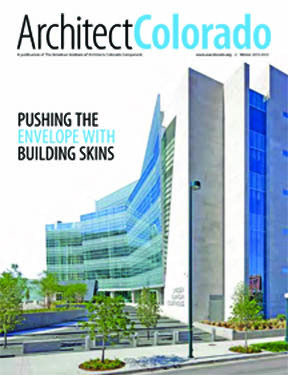
Read the article here
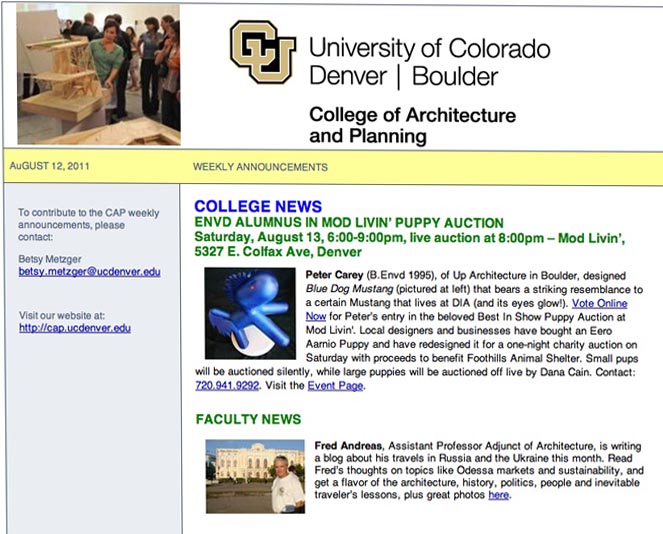
Fred recently explored the Ukraine, check out his blog with photos!

We are pleased to announce there will be 2 book signings to promote the book Fred co-authored, A Simple Path to Sustainability!
Link to A Simple Path to Sustainability on Amazon.com

Please join Fred and many other professionals at the Sustainability Series held at the Wynkoop Brewery.

RASEI's Website
FIRST Tuesday of Month at 6pm at Wynkoop Brewery, unless otherwise noted The Sustainability Series is a monthly networking forum for the public to learn and discuss how local Front Range universities, business, not-for-profit organizations, and governmental agencies have incorporated and defined sustainability in innovative and progressive ways. Design for the Other 90% and Sustainability Park August 2 Wirth Chair Sustainability Series “RASEI” August 2, 6:00 - 8:00 PM at Wynkoop Brewery, 1634 18th Street Mike Knotek: Director of RASEI, CU Boulder RASEI is a joint institute of the University of Colorado (CU-Boulder) and the National Renewable Energy Laboratory (NREL) to expedite the energy industries of the 21st century by advancing renewable energy research, engineering, and analysis. RASEI forms the center of an integrated energy campus by combining the best of NREL’s mission and capabilities with the education and scholarship of CU-Boulder, in partnership with industry and other federal research labs for a new generation of research. Learn about RASEI’s cutting edge projects at the August 2 Wirth Chair Sustainability Series!We are very excited to invite you all to Net Impact’s Spring 2011 Event on April 15th:

Net Impact's Website
Designing Tomorrow’s Sustainable Communities There will be a panel discussion including representatives from: Colorado Coalition for the Homeless Living City Block University of Colorado Boulder’s School of Architecture UNiT Design Studio The Alliance Center Spector & Associates, PC The panel will be moderated by University of Colorado Denver Business School’s Ira Selkowitz. Details for the evening: When: April 15th, 2011 from 6:00 PM to 8:30 PM Price: Free admission and free food. Food: Come early at 6pm for a bite to eat. Where: North Classroom Building Room 1130, Auraria Campus Time: 6:00-6:30: Socializing/Networking and Food/Refreshments 6:30-8:00: Panel Discussion moderated by Ira Selkowitz 8:00-8:30: Socializing/Networking with panel members If you are interested in attending the event, RSVP to ucdnetimpact@gmail.comor visit our Facebook page (http://www.facebook.com/NetImpactUCD) and RSVP to our event. We look forward to seeing you there! Net Impact University of Colorado Denver chapter www.ucdnetimpact.com ucdnetimpact@gmail.comCheck out Fred's portion of the GEO Webinar on The New Frontiers in High Performance Design

Theme by Danetsoft and Danang Probo Sayekti inspired by Maksimer